
by Megan N
Indian Myths and Legends: The Pleiades – The Creation – The Coming of the Chinigchinich – The Island of the Dead By Reuben Kadish
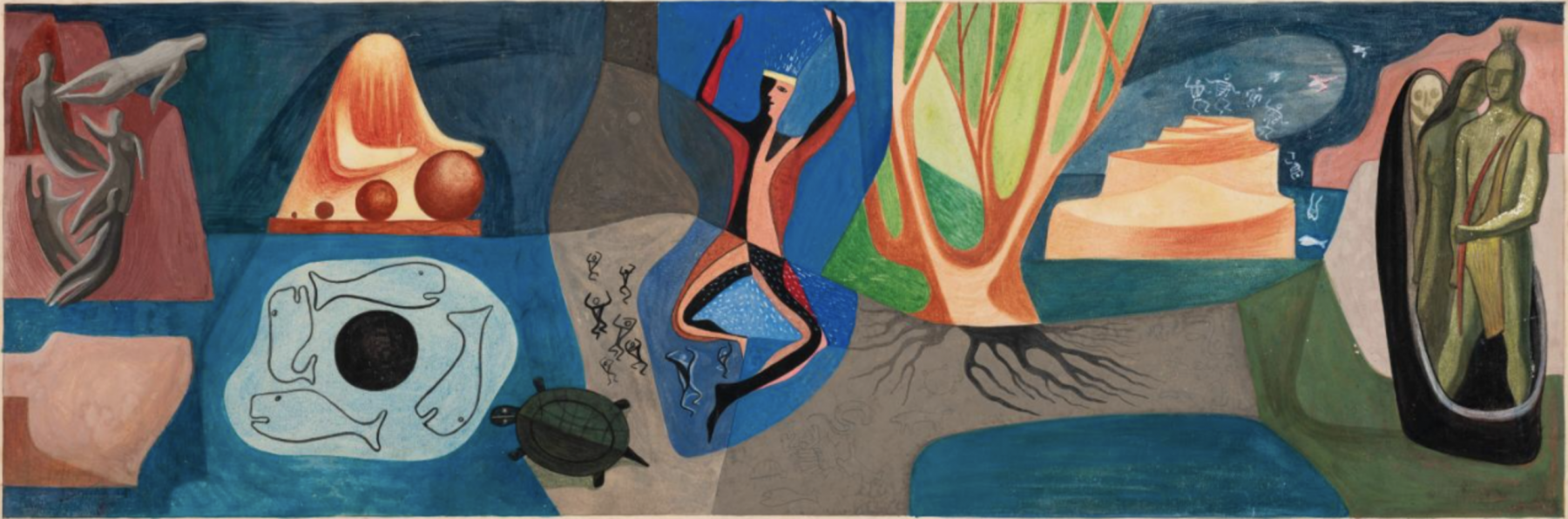
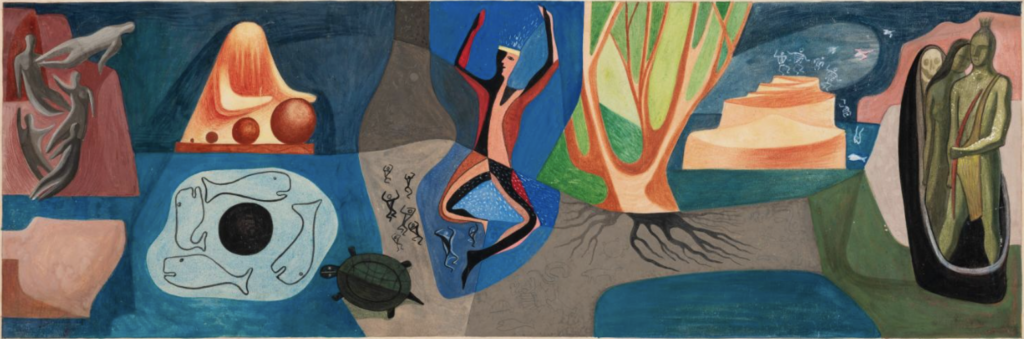
The first piece I saw on the recent Austin DSA “field trip” to the Blanton Museum of Art was Indian Myths and Legends: The Pleiades – The Creation – The Coming of the Chinigchinich – The Island of the Dead (1937-41) by Reuben Kadish1. It wasn’t really fair to the rest of the works in the exhibit, to start off so strong.
The blurb in the museum said he was born to immigrant parents from Kovno, or presently Lithuania. His Wikipedia page2 adds the context that this land was under the Russian Empire at the time of his birth, and that his father had been a part of the General Jewish Labor Bund, a secular Jewish socialist party, before emigrating. Wikipedia does not mention his mother, Ida Saks, whose name I found from a biography website that seems to have been written by a descendent3.
As an artist for the Works Progress Administration (WPA), Kadish made plans and sketched “studies” for as many as twenty murals, but only two were accepted and completed: Physical Growth of Man / History of Medicine (1936)4 and Dissertation on Alchemy (1937)5. Both were heavily inspired by his time in Mexico with muralist David Alfaro Siqueiros. The museum label said he ascribed his rejections to their being “too flamboyant, too revolutionary, too this, too that.” Regardless, he still got paid for coming up with ideas. Artists hired for the WPA were salaried and paid by the week, not by commission or output.
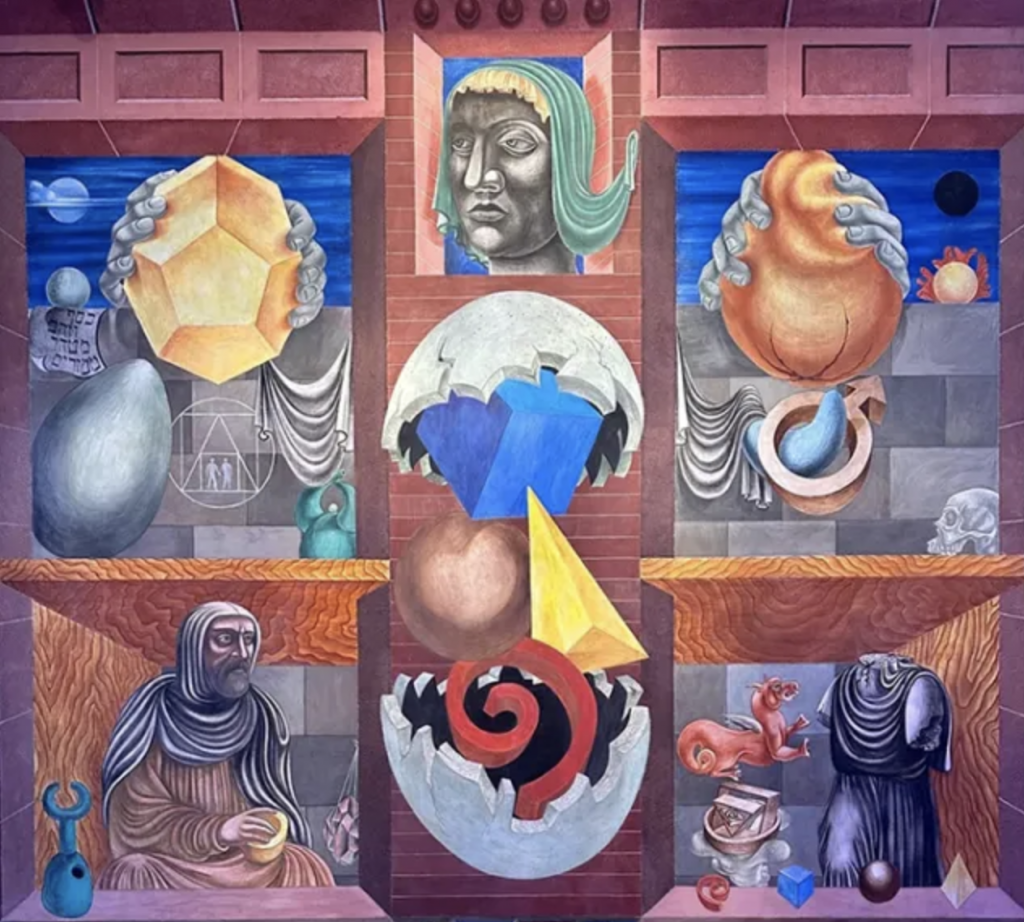
Left: Photograph of Dissertation on Alchemy (1937) by Reuben Kadish.
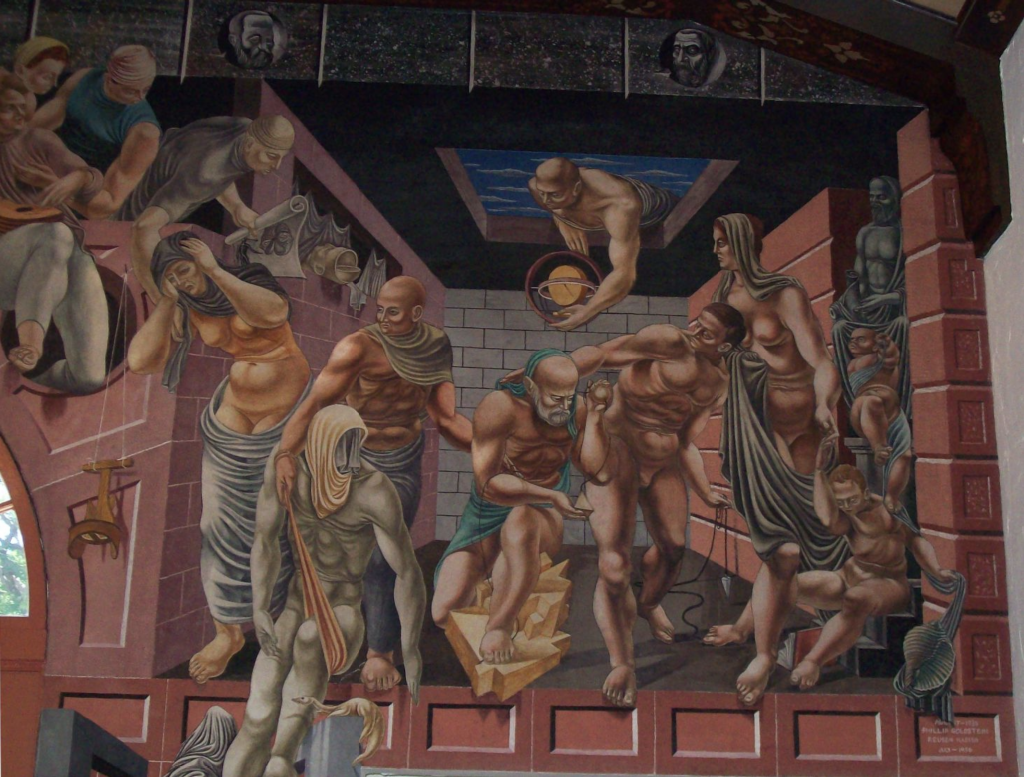
Right: Photograph of a section of Physical Growth of Man/History of Medicine (1936) by Reuben Kadish and Philip Guston.
Among those flamboyant and revolutionary rejections was Indian Myths and Legends. I’m a sucker for anything with space references in it. The Pleiades is a star cluster that has six stars visible to the unaided, 20/20 eye; seven, if you are atop a mountain with perfectly clear skies and a new moon; and over a thousand stars if you have a telescope to help you out. The Western understanding of the Pleiades as the “Seven Sisters” comes from Greek mythology, as many of our astronomical names do. The Greek story involves young women, all mothers, who were fleeing the hunter Orion (a nearby constellation) who relentlessly pursued them for their beauty.
It’s one of the myths that’s strikingly similar across the world. Kadish lived in southern California for most of his life, where the Payómkawichum (Luiseño) and Tongva (Gabrieliño, Fernandeño)6 peoples understood the Pleiades as women escaping death by retreating to the skies. I could not find why the women were fleeing death in the Payómkawichum version, but they do so via a rope, and they cut the rope while a man is trailing behind them. He ends up as a bright star separate from the Pleiades, in the constellation we know as Taurus7. In the Tongva tale, the women “found out their partners were holding back food from the community” and catapulted themselves into space. One of the men came back home with food for his partner after all, and loved her so much that he, too, rushed to the skies, becoming the entirety of Taurus8.
Kadish’s representation sits six cave-like drawings of bodies at the center-left on a gray background, with two more to the right, these separated on a blue background and sitting just underneath a large red-and-black body that I presume represents the men in the stories who followed the women into space, lagging just behind.
How curious that the Pleiades cluster, visible from most of Earth in the winter as long as you’re not at the South Pole, has been so universally perceived as women, let alone as runaways and escape artists. The stories almost certainly predate ancient Greece9. Kadish’s depiction mostly evades gender, but I don’t know if the work would have struck me in the same way without its amorphous bodies swimming alongside the fish, without the sharp skeletons dancing on their postmortem island.
I found no history or analysis of this piece online. I wonder from whom he heard these stories, and what he hoped to convey to Americans had it become a WPA-sponsored mural after all. Kadish’s political convictions were no secret; he and Philip Guston are responsible for a mural in Mexico so momentous that it has multiple names (though I favor The Struggle against War and Fascism). The mural had to be hidden behind a fake wall for three decades after being deemed offensive by the Catholic Church. Both men were also targeted by the Los Angeles police’s “Red Squads” for making art with the Marxist-affiliated John Reed Clubs to protest the racist trial of the Scottsboro Boys10. The LAPD didn’t just destroy a dozen paintings, they shot at the people depicted in each one. Kadish was already familiar with this kind of persecution: his childhood home had been ransacked for his father’s “Bolshevik sympathies.” He continually spoke about worker’s rights and the abolition of class in interviews throughout his life. Why the artistic focus on indigenous mythology?
In 1943, not long after his stint with the WPA, Kadish was recruited to document the war as an Army artist. In an interview conducted with Kadish a few months before his passing in 1992, he had this to say about the impact of the war on his art:
“Well, you can’t have the impact of the horrendousness of the kind of death that the world had seen without asking yourself some questions as to where we came from and where do we think we’re going, and who’s your mother and who’s your father, and who do you think you can choose to find in this world of ours? … In all religions, and when we read the [stories] that seem to be most gratifying … they’re the ones that we least understand. They’re the ones that have more poetic elements in them, that carry out more than just the fringe of what a mother figure is all about.”11
But Indian Myths was made before Kadish had seen that “kind of death” up close in a war. He was clearly thinking about storytelling, creation, and loss before then. Did he witness another kind of death in his youth that compelled his interest in these themes? Political repression and the police state followed him throughout his formative years. Yet his art highlighted the humanity of nearly everyone but himself. Kadish chose solidarity, reminding us that we achieve universal dreams of peace and livelihood by working as a collective, that disconnected people across the world can look at a blurry patch of sky and see the same vision.
Works Cited
- https://blanton.emuseum.com/objects/21172/
- https://en.wikipedia.org/wiki/Reuben_Kadish
- https://kadishart.org/biography-reuben/
- https://livingnewdeal.org/sites/city-of-hope-guston-and-kadish-mural-duarte-ca/
- https://digitalcollections.sdsu.edu/do/814f8546-f84f-41bc-9082-74c4f41b1af4
- I only provided the Spanish-given names to make one’s independent research easier, as I found these names were used more often in text.
- https://www.caltech.edu/about/news/before-the-telescope
- https://www.lacountyarts.org/experiences/civic-art/memory-and-futurity-yaangna
- https://theconversation.com/the-worlds-oldest-story-astronomers-say-global-myths-about-seven-sisters-stars-may-reach-back-100-000-years-151568
- https://reubenkadish.org/publication/double-consciousness-in-mexico/
- https://www.aaa.si.edu/collections/interviews/oral-history-interview-reuben-kadish-12170