
By: Gumbo V
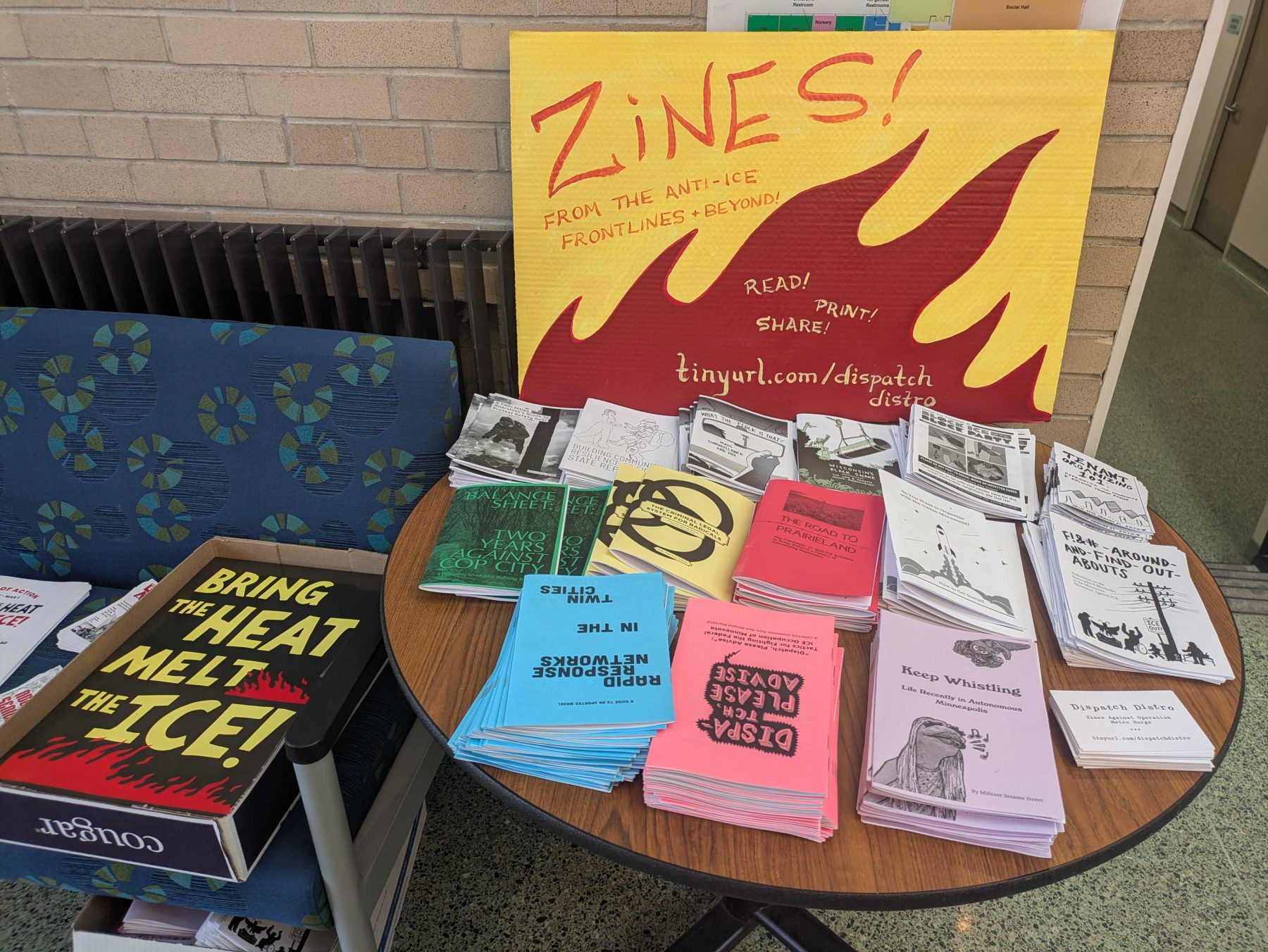
Late February is a frigid time to visit Minneapolis, Minnesota, but the people of the Twin Cities are no strangers to fending off ICE. I had the honor of visiting Minneapolis from 25 February to 1 March 2026 for their Bring the Heat, Melt the ICE Week of Action, which brought in organizers from across the country to learn firsthand how Minnesotans have resisted the occupation of their cities by federal agents through an inspiring diversity of tactics. There were a variety of activities to participate in each day, from training sessions to ridealongs with ICEwatch patrols; noise demos to blockades on critical facilities; protest marches to Block ICE block parties—a “choose your own adventure” of movement learning. Week of Action organizers acknowledged in the welcome packet that “the strongest movements are made up of well-connected individuals across far reaches of time and space,” and sought to provide as many opportunities as possible for attendees to experience the breadth of their historic resistance.
Days 1-2 – Orientation & Suburban Patrol
My experience in Minneapolis began early Wednesday morning, 25 February 2026, as I left behind the near-90° heat in Texas and stepped out of the airport into sub-freezing winds to meet a comrade from Twin Cities DSA, Brooke B, who would be my host for the week. I briefly interviewed Brooke about her own perspective on the developments in Minneapolis, then we spent the rest of the day in training sessions hosted by Minneapolis rapid responders (many of whom were Twin Cities DSA members). Workshop sessions covered Know-Your-Rights business canvassing with a focus on organizing the workers at canvassed locations, the basics of the neighborhood rapid response model, and a thorough 2-hour session on the bread and butter of rapid response in practice. At the end of the day, attendees were invited to join neighborhood chats based on where in Minneapolis we were staying and get ready to patrol the following day.
On Thursday, I joined a rural/suburban patrol session, which began with a short training led by Tinkerbell and Mama Bear (most folks go by their Signal usernames as a matter of precaution). Brooke then took me and another comrade from northern California out on patrol in the city of Hopkins, a suburb of Minneapolis. We joined a live call on Signal to check in with dispatch, who asked us to check a list of areas where ICE had been seen lurking in recent weeks. The suburban patrol felt very similar to patrolling I have done in Austin—a lot of driving around from parking lot to parking lot, scoping out vehicles with heavily-tinted windows or out-of-state license plates, and trying not to be too paranoid. Border Czar Tom Homan, appointed to replace Nazi fanboy Greg Bovino as head of Operation Metro Surge at the end of January, had announced the “end” of the operation just two weeks prior, and organizers on the ground had noted a slow withdrawal of immigration officers coupled with a change in their tactics. ICE and CBP agents were no longer roving openly in their military garb but had instead shifted to more clandestine, plainclothes tactics to continue carrying out their abductions from a rotating cast of Enterprise rental cars. Comrades noted that this seemed to be a direct result of the strength of resistance efforts up to that point.
Dispatch, Please Advise
Let us pause here to discuss what is meant by patrol and dispatch. I will not go into the system at length, as it has been described in great detail in the piece “Rapid Response Networks in the Twin Cities: A Guide to an Updated Model” on CrimethInc.com, but I will discuss my personal experience with the tool. Patrolling (or commuting, as some in the Twin Cities have taken to calling it) is rather straightforward: get in your car, hop on a bike, or just throw on a coat and some walking shoes and roam your neighborhood looking for potential ICE activity. At first, patrolling was both decentralized and largely disorganized, but it rapidly became highly organized while remaining decentralized, a key to its success. By the time of the Week of Action, there were dozens, if not hundreds of neighborhood groups at varying levels of granularity, from the larger regional channels like Southside Minneapolis, to local and even hyperlocal chats consisting of as few as 3-4 city blocks. Within each geographic unit, people would be out patrolling during the day, or would join each of the respective neighborhoods along their commute to and from work; hence, commuting.
The rapid response networks in Minneapolis scaled up incredibly quickly. Consequently, they needed a better system of coordinating between the various responders on the ground. Enter: the dispatch system. Dispatch started at the Whipple federal building (see below), where initially organizers would stage in vehicles nearby and commute behind ICE agents as they exited the facility to give advance warning to the neighborhoods they entered. Over time, the ICE agents began harassing observers at Whipple more and more, so organizers adapted their tactics in response. By having a dispatcher offsite start a running call on a Signal chat, they were able to take some of the pressure of note-taking off of people on the ground. Instead of having to simultaneously take pictures of vehicles and note their license plates (or lack thereof), observers could call out the plate numbers verbally and a dispatcher would transcribe them. Dispatchers also assisted in directing more people to back up observers who were being harassed by ICE agents.
The dispatch system proved highly effective, so it spread throughout the neighborhood groups as well. Dispatchers began organizing amongst themselves to schedule shifts, train up new dispatchers, and export the system to new areas. Dispatchers would identify themselves using a phone emoji (☎️) in their signal name and add a green dot (🟢) or an X emoji (❌) when they were on-shift, which led to an ingenious emoji code for quickly communicating one’s role in the wider network.
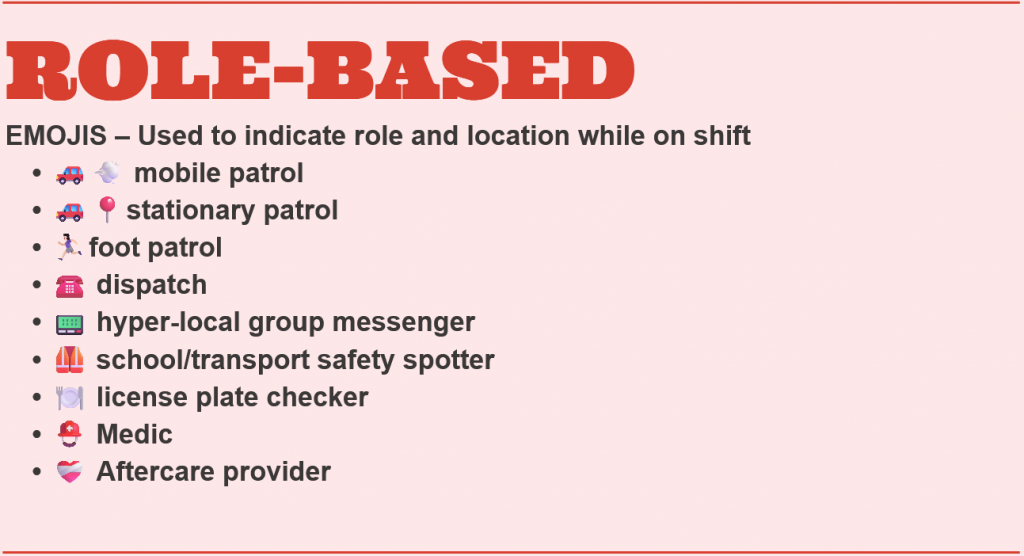
I was especially fascinated by the dispatch and emoji code aspect of the rapid response network. In my day job, I often act as a dispatcher for field crews to barricade flooded roads; my role is to look at the city from a bird’s eye view, monitor for flooding conditions, and send crews to the areas of concern to take action while I update the public about the hazard. The Minneapolis dispatch system is a powerful mirror of my own job, and one that organizers arrived at organically out of immediate need. Dispatchers are not only tasked with transcribing license plate numbers, but also checking plates against the database to confirm if they are ICE and, crucially, coordinating patrollers across wide geographical areas so that they maintain full coverage of a neighborhood at all times. One training session described it quite simply: if every single patroller converges on the first confirmed ICE activity of the day, that leaves the rest of the entire neighborhood as open season for other ICE agents.
Dispatchers thus have to manage several people at once (many or most of them total strangers!), keep them on target in their areas of coverage, and often talk them through difficult situations when they have ICE encounters themselves. A comrade in TCDSA shared during the rapid response training on Wednesday evening that he was the dispatcher on-shift when Alex Pretti was murdered by CBP agents at the corner of Nicollet Ave and 26th St. He had to talk the observers on the scene through the situation, help them navigate to safety, and gather as much information as possible about the incident. Though miles away himself, he was very much on the ground with everyone else. Another comrade told me later that it was the first time he had ever talked about that experience publicly.
Day 3 – Whipple Watch
Friday was Whipple Watch day. The intelligence-gathering operations outside the Bishop Henry Whipple federal building have been instrumental to the rapid response network in Minneapolis, affectionately dubbed “Whipple Watch” by organizers. Interestingly, the Whipple building is part of the Fort Snelling complex, which was historically used as a concentration camp for Dakota and Ho-Chunk people who were forcibly removed from their homelands during the Dakota War of 1862; it was also home to Dred and Harriet Robinson Scott who were enslaved there in the 1830s and whom the U.S. Supreme Court’s infamous Dred Scott Decision ruled were not extended citizenship by the U.S. Constitution. Whipple now serves as an ICE field office and a detention center for immigrants and citizens alike.
Every day since the start of Operation Metro Surge, comrades have staked out the Whipple building beginning around 5am and often lasting until late in the evening. They log every single vehicle that enters or departs from the building carrying ICE agents, gathering data including license plate numbers, vehicle makes and models, photos, and even directions of travel along Federal Blvd in front of the building. These data are sent to a Signal chat that is recreated anew every morning where offsite organizers compile the information into a database that is accessible to rapid responders across the cities. Noting the direction of travel helps dispatchers know which neighborhoods the convoys of ICE agents are likely to target that day, with southbound convoys headed to southside Minneapolis and northbound convoys likely to target areas near downtown or in suburbs. One vehicle we observed leaving the facility in the two hours we were there was reported as making an abduction just thirty minutes later.
The utility of the intelligence-gathering operations outside of Whipple cannot be overstated. Minnesotans have the “benefit” of a less overtly evil state government compared to Texas under Greg Abbott, which has meant that Minneapolis police, Hennepin County sheriffs, and Minnesota state troopers are not directly collaborating with ICE agents to conduct traffic stops. Thus, ICE agents have to commute to a centralized location (Whipple) to mobilize for their operations, and rapid response organizers are better able to track them. The data gathered at Whipple Watch feeds a decentralized network across the cities that enables rapid responders on patrol in their neighborhoods to verify whether a vehicle prowling their block has been observed in ICE operations and rapidly mobilize a response if the plate check comes back positive, oftentimes before those agents are able to abduct anyone. Without that intelligence, rapid responders would be forced into a posture of constant reaction, rather than being proactive with their neighborhood defense.
As an aside, the conduct of the ICE agents at Whipple was notably abhorrent. I had no expectations of them whatsoever, but I was primed to expect the stony-faced, vacant-eyed stares of cops in riot gear that I’ve seen at protests in Austin. They are law enforcement officers, after all, and there is a certain demeanor that often comes with that position. The ICE agents in Minneapolis, however, were openly belligerent towards people at Whipple. Although Whipple Watch had been ongoing since December, protests began targeting the building directly, sometimes escalating to barricading the exits to prevent ICE agents from departing for their daily toil of kidnapping people off the streets. In response, ICE and Hennepin County sheriff’s deputies erected concrete barricades topped with 8-foot chainlink fencing around the entire complex, which effectively created a chainlink tunnel along Federal Blvd that could only be accessed by car. Ironically, this also blocked one of the three gates that ICE agents would use to come and go from Whipple, limiting the number of gates that observers had to watch to two.
Whipple has since become a site of catharsis for many in the community, who will go to yell at ICE through megaphones to blow off steam after long hours patrolling their own neighborhoods. While we were there for Whipple Watch, others arrived simply to yell at the ICE agents and demoralize them. Rather than take it on the chin, as many cops are trained to do, these agents yelled back, threw water bottles out their windows, filmed protestors, and repeatedly flipped us off while grinning through their fully-masked face coverings. One comrade who helped start Whipple Watch in December told me that she was there early one morning, recording vehicles as they came and went, and agents rolled their windows down to call her a “red-headed cunt,” though she hadn’t said a word to them prior. They just seemed to thrive on the cruelty.
After Whipple Watch, we headed downtown for foot patrolling. Again, we joined a live Signal call with a dispatcher and embarked from the Minneapolis Central Library to crisscross the tightly-packed downtown core. Comrades in TCDSA noted that enforcement operations were less common in downtown Minneapolis because of its proximity to financial centers, and there seemed to be an implicit agreement between federal forces and the instruments of capital that too much disruption to the flow of money was unacceptable. As a result, rapid responders in downtown Minneapolis focused more on business canvassing, both organizing workers and businesses to know their rights should ICE arrive on the property and building support for the 23 January 2026 general work stoppage.
After a break for lunch at a worker-owned, cash-only deli co-op, we met with a protest march and walking tour. Led by a truck loaded down with loudspeakers, we marched past hotels where ICE agents had been staying, CBS News offices, and the headquarters for Target and other complicit corporations. At each stop, a new organizer came up to speak to the crowd about exactly how the corporate targets were wrapped up in the ongoing occupation of the Twin Cities. There was not a single cop in sight for the entire march; protest marshals handled all of the traffic for at least one block on either side and two blocks out ahead of the march, using a combination of bike marshals as a vanguard to seize intersections and foot marshals to leapfrog from block to block keeping the cross traffic away from marchers.
Day 4-5 – Solo Patrol & Closing Notes
I spent most of Saturday at the Twin Cities DSA annual chapter convention. Late in 2025, TCDSA passed a Contingency Plan in anticipation of escalated ICE operations. The Contingency Plan outlined a process by which either a majority of the general membership or two-thirds supermajority of the Steering Committee could declare an emergency and pause all other chapter activities so as to focus all comrades’ efforts on the emergency at hand. TCDSA activated this Contingency Plan in December, shortly after Metro Surge began, and had only just started to revive other sectors of chapter organizing while I was visiting. Saturday morning was also when news broke of the joint US-Israeli war on Iran, and Week of Action organizers were already planning a protest tying together the threads of imperialism abroad and racist, militarized immigration enforcement at home.
I left the chapter convention in the early afternoon to find coffee and a snack. I love all my comrades, but much of the debate at the TCDSA convention was of less interest to me than the resistance to ICE operations in the cities. While walking to a local bakery several blocks away, I asked Week of Action organizers which neighborhood aligned with where I was walking and was quickly added to the Longfellow/Seward neighborhood chat. I got my coffee and a pastry and then spent a few hours on the call with dispatch and other foot patrollers, walking throughout the Long-Sew neighborhood in the single-digit cold checking plates and looking for ICE. Thankfully, all I saw was the kind that freezes hard to the ground and makes you slip if you aren’t careful with how you walk (my hosts, Brooke and Sean, taught me how best to shuffle across slick patches of ice so I wouldn’t fall, something ICE agents would’ve done well to practice).
Sunday was spent recovering from the high intensity of the week and visiting a frozen lake with my hosts (a personal first!) before boarding my plane for home in the balmy 85° Austin heat. I never saw an actual ICE operation while I was in Minneapolis, but I felt their presence throughout the cities nonetheless. It was a contradiction I discussed endlessly with my hosts and comrades whom I met: I wanted them to have a good day, with no abductions, but I also felt a responsibility to see those abductions in progress to get an idea of just how bad it might get in Texas (even worse than it already is). Despite never seeing ICE abductions in progress, I felt the community’s eyes on me constantly. There were times when I took a smoke break outside the Week of Action training locations or departed on my own to walk around and explore, and I could feel people watching me. The watching was rarely overt, but it was palpable—a father’s eyes lingering on me as he walked his child home from school; cars slowing down as they passed me by; a second glance from people on the sidewalk. I may have been there for a good reason, but they had no way of knowing; to them, I was a stranger, and a white, male-presenting one in cowboy boots at that. I never felt unwelcome by this attention, I only felt appropriately observed, because for all they knew I could be a plainclothes agent and their priority was keeping each other safe. Driving around in the mornings, I saw huddles of adults chaperoning children to their bus stops, and in the afternoons those chaperones escorted kids from the stops to their houses.
Minneapolis has been a site of struggle for decades, and even more recently as the epicenter of the George Floyd Uprisings in the summer of 2020. The people there are kind, their hearts so warm they could melt the snow that engulfed their streets, but they did not ask to be thrust into the national spotlight once again. To call them resilient feels belittling, much as I take issue with those who label all of us from the Gulf Coast “resilient” and “strong” for weathering the polycrisis of climate disasters, extractive industries, and negligent-at-best governments. Nonetheless, the Twin Cities have fought hard and they are lighting the way for the rest of us in struggle. Truly, the people, united, can never be defeated.