
by R.K. Upadhya
The American Civil War is a key moment of US history. If you grew up in the US, you almost certainly spent a good chunk of time in grade school learning about the Civil War. It is also likely the case that this education was boring and unengaging. This is a tragedy, for in fact the Civil War era had profoundly radical and revolutionary dimensions, and should be a source of education and inspiration for the modern Left and the US socialist movement. Case in point: after Abraham Lincoln’s re-election victory in 1864, Karl Marx himself helped pen a letter of congratulations to Lincoln, celebrating the Union cause as a universal interest of the working class, and encouraged him toward complete victory over the Southern slavers. It is not often that we think of Marx and Lincoln as being contemporaneous – but they were, and while it is unknown if Lincoln actually read Marx’s letter, it is likely that Lincoln read at least some of Marx’s many articles in the New York Daily Tribune.
The Civil War was the culmination of the abolitionist movement, which emerged out of free Black communities of the North, and the slave revolts which rocked the South in the 1830s. And the abolitionist movement is where the US Left was truly born; it was in this fiery struggle against slavery that many of the ideas we hold dear today – anti-racism, democracy, anti-imperialism, and anti-capitalism – went mainstream and became a permanent part of American politics. There is a grand history for how this happened, with many moving parts. But one fascinating thread is the way in which the abolitionist movement in the US was connected with the emerging revolutionary socialist movement in Europe. Abolitionism being the birthplace of the American Left wasn’t just a matter of converging values, but based on a direct exchange of ideas and militants between the US and Europe – and in particular, the cohorts of revolutionary German exiles who immigrated to America in the 1850s.
Historical Context
The abolitionist movement started in earnest in the 1830s, after Nat Turner’s Rebellion in 1831, which galvanized free Black communities across the North and put an end to any doubts that enslaved people were happy with their lot in life. Over the course of the next few decades, it grew dramatically in popularity, organization, and militancy; its electoral expression was the Republican Party, founded in 1854, while its more revolutionary tendency was expressed via the likes of John Brown, Harriet Tubman, and other insurgent figures. By the 1850s, the question of slavery was the defining political issue in the US, fostering an intense amount of political and civil unrest.
At the same time, Europe was also undergoing convulsions. In parallel to the growth of the abolitionist movement in the US, the revolutionary socialist movement was growing, and founding figures like Karl Marx and Fredrich Engels were coming into the spotlight. The tremors finally erupted into an earthquake in 1848, when a wave of uprisings and revolutions shook the foundations of Europe, particularly in Germany. Workers, peasants, and other parts of a “revolutionary citizenry” assaulted and overthrew centers of monarchical and feudal power. Marx and Engels wrote and published The Communist Manifesto during this tumult; Engels himself was in the streets as a revolutionary soldier.
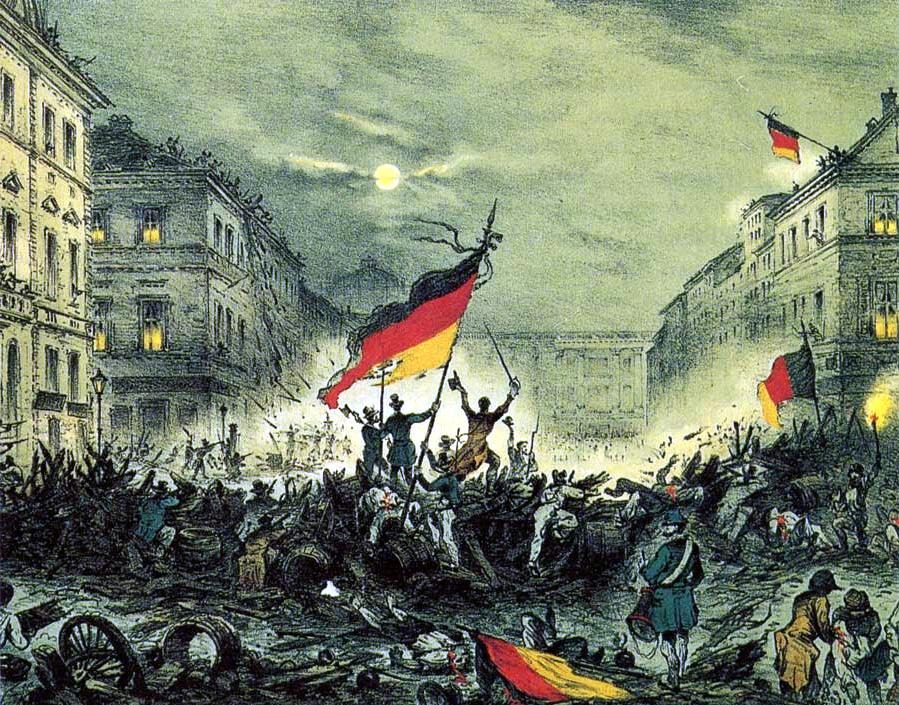
Unfortunately, the revolution in Germany gets crushed, and millions of Germans escape to Western Europe and beyond, fleeing harsh counter-revolutionary reprisals as well as general economic ruin. Many of these refugees and exiles end up in the United States; about one million Germans emigrated to America in the 1850s. And among this number, roughly 4,000 were hardcore revolutionaries, socialists and communists, organizers and militants, in addition to tens of thousands more supporters, followers, and sympathizers. This cohort was known as the “Forty Eighters”, exiles of the 1848 Revolution. And once in the US, the Forty Eighters immediately bolstered the ranks of an increasingly revolutionary abolitionist movement. This was a natural alliance; the nature of the Southern slaver elites was an uncanny mirror image of the tyrannical aristocrats that they had attempted to overthrow at home. And for the abolitionist movement, these veterans brought military experience, organizational discipline, and expansive ideas about liberty, labor, and capitalism, which coupled well with the parallel works of the leading abolitionist intellectuals.
Colonel Weydemeyer and General Willich
Two figures in particular represent the radical edge of the Forty Eighter abolitionists: Joseph Weydemeyer and August Willich. Both of these men were German communists and revolutionaries, who eventually ended up as high-ranking military officers in the Union Army.
The initial trajectories of the two men were similar. Both were Prussian military officers in the 1840s, who became radicalized by Marx’s writings about capitalism, class, and revolution. They rebelled in 1848 on the side of the Revolution, and fled west when the revolution was crushed. They made personal acquaintance with Karl Marx in London, and joined the Communist League and helped further develop revolutionary socialist politics in Europe. After a few years, both men emigrated to the United States, where they planted themselves among fellow Forty Eighters and made a living via political organizing and radical intellectual writings. And when the Civil War began, they enlisted along with large numbers of fellow Germans, and quickly rose up the ranks due to their previous military experience and their political fervour.
Compared to Willich, Weydemeyer was more of an intellectual type. He was a friend of Marx and Engels; in fact, it was Marx who directly suggested to Weydemeyer that he emigrate to New York City. Once there, he quickly got to work in left-wing journalism and organizing, joining a growing cohort of revolutionary Marxist voices that joined the abolitionist movement. He was a co-founder of what was arguably the first socialist organization in the United States, the American Workers League (which, despite its broad name, was almost entirely an organization of radical German immigrants). This group would later become the New York Communist Club.
When the Civil War began, Weydemeyer enlisted and quickly ended up as a technical aide to General Fremont, an abolitionist and a radical rival to Abraham Lincoln. Within a year, Weydemeyer was a Lieutenant Colonel and in charge of a volunteer artillery regiment. Later on in the war, he served as a Colonel of the 41st Missouri Infantry Regiment. Amusingly, throughout his active duty service, Weydemeyer kept up his intellectual pursuits, exchanging letters with Marx and Engels about the war, writing opinion pieces for local newspapers near his posts, and engaging in local debates. In 1864, when Marx helped found the International Workingmen’s Association (a.k.a., the First International), Weydemeyer printed out copies of the inaugural address and passed it out to his men (it is unclear how many of these Missouri infantrymen subsequently joined the cause of international communism).
After the war, Weydemeyer remained in politics, winning an election for the St. Louis County auditor. He ran the office as a Marxist, using his powers to strengthen tax laws and chase down war profiteers. Unfortunately, his tenure was short-lived; Weydemeyer passed away in August 1866 from cholera.
August Willich led a similarly colorful life, albeit one more oriented around military affairs.
An excellent book on his entire life, only a tiny fraction of which can be discussed here, is Radical Warrior: August Willich’s Journey From German Revolutionary to Union General.
Like Joseph Weydemeyer, Willich also knew Marx & Engels; indeed, Engels was Willich’s right-hand man during several battles in the final stages of the 1848 Revolution. But unlike Weydemeyer, Willich did not like Marx at all. Willich led the left-wing faction of the Communist League, and thought Marx was too conservative and was not eager enough to wage revolutionary struggle; for his part, Marx was not impressed by Willich’s intellectual standing. There may have also been some more personal animosity at play; Willich apparently was quite interested in Marx’s wife, Jenny, and would regularly come visit her at their home in London and engage her in long conversations about theory and politics. As Jenny Marx described, “He would come to visit me because he wanted to pursue the worm that lies in every marriage and coax it out.” It’s not clear if Willich ever coaxed out the worm; within a few years, he emigrated to the United States, engaged in radical writing, and organized among other German immigrants and Forty Eighters in the midwest.
When the Civil War began, Willich played an important role in recruiting fellow Germans into the military; he would become a Colonel, and then a General in command of an all-German infantry unit, the 32nd Indiana Infantry Regiment. Willich and his men quickly distinguished himself on the battlefield, helping win one of the few Union victories in 1861 at the Battle of Rowlett Station in Kentucky. This battle saw about 500 German infantrymen defeat over 1,000 Texas Rangers and assorted Confederate infantry. This battle is also commemorated in what is the oldest surviving Civil War monument, the Bloedner Monument, which was carved by a member of the regiment a couple of weeks after the battle. It’s a remarkable piece of history, since it’s likely that this battle is mentioned in many Civil War textbooks – but the radical historical context, that this victory was one of a revolutionary communist veteran and other revolutionary exiles, is papered over or ignored.
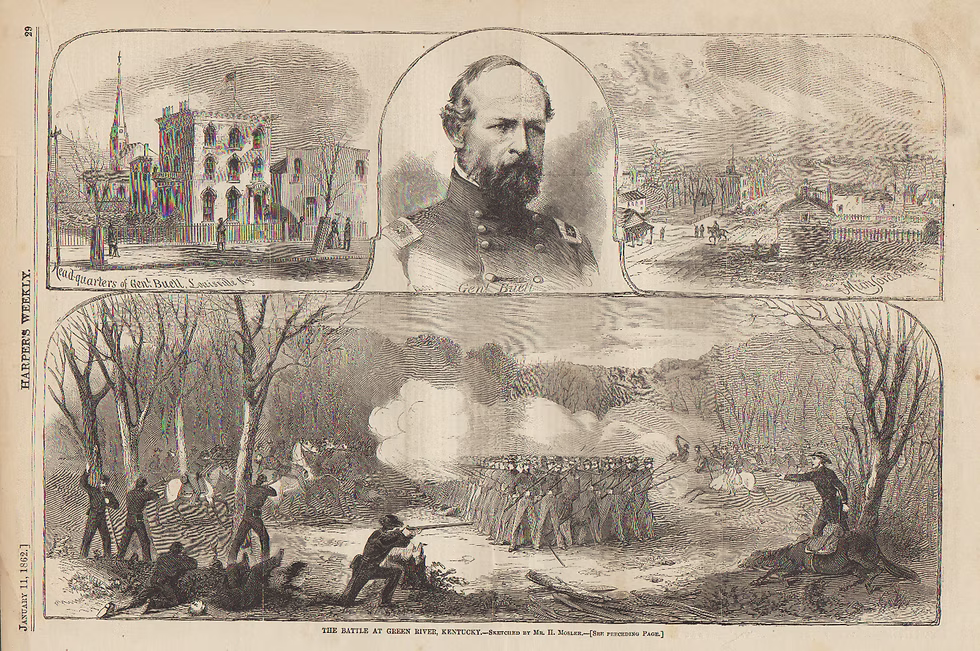
Willich and the 32nd would go on to fight in other major Civil War battles, including the 1862 Battle of Shiloh, the 1863 Siege of Chattanooga, and General Sherman’s “March to the Sea” in 1864. After the war, just like Weydemeyer, Willich went into government service and was elected as a county auditor in Ohio. In his later years, he went into academia. August Willich passed away in 1878.
Forty Eighters in Texas
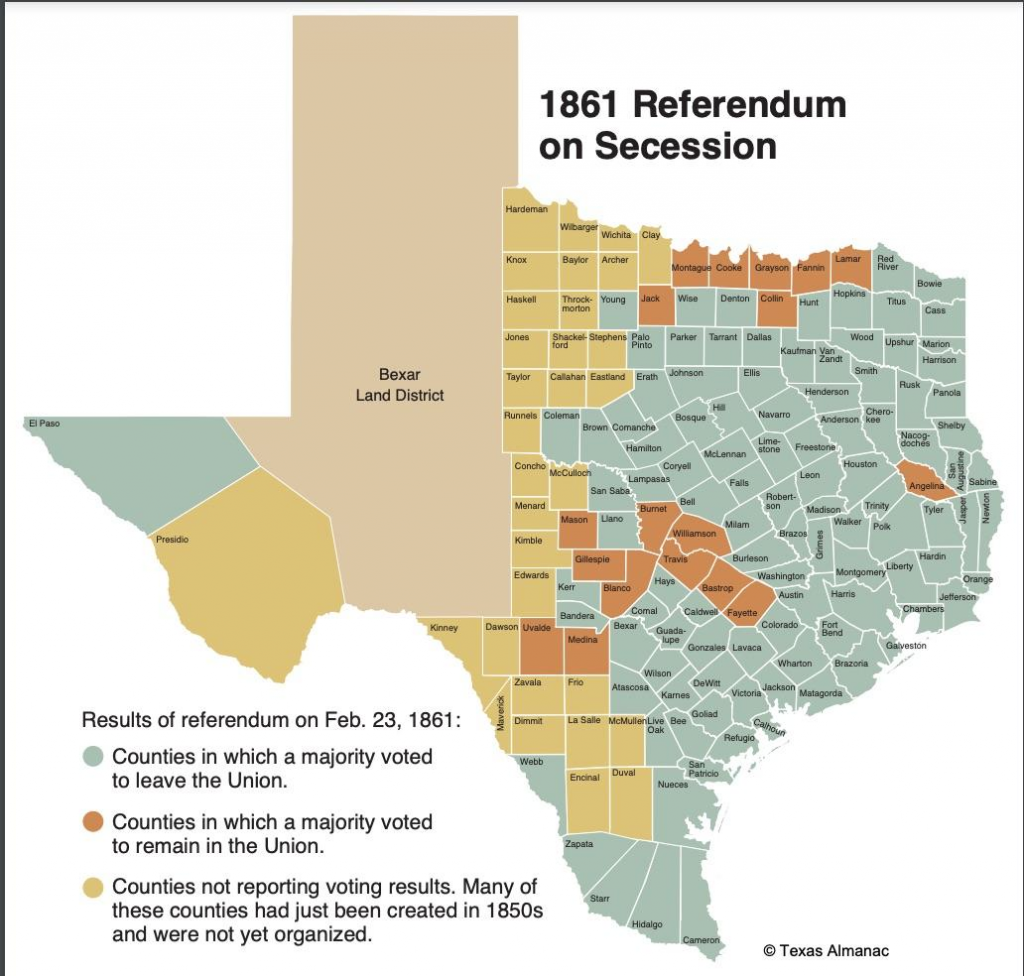
The legacy of the Forty Eighters is also present right here in central Texas, where many Germans settled in the 1850s. San Antonio and the Hill Country were particularly popular – a legacy that still continues today, with cities like New Braunfels and Fredericksburg remaining centers of German culture, as well as smaller towns like Boerne and Comfort. Despite being in a southern slave state, just like their brethren in the midwest and the north-east, German immigrants to Texas were generally anti-slavery and pro-Union. In 1854, Germans in San Antonio caused a major political firestorm when they held a convention and passed a resolution condemning slavery. In 1861, during the Referendum on Secession, the counties with the most Germans tended to vote against secession.
As the war progressed, repression against Unionists escalated, with Germans being a major target. In 1862, the Confederacy passed a conscription law to mandate military service, which provoked German Texans Unionists to escalate into armed resistance – which in turn, brought martial law across the Hill Country and waves of violent reprisals. The struggle culminated in August 1862, when a band of Germans gathered up arms and attempted to escape to Mexico. Unfortunately, the Confederates caught wind and chased them down, eventually cornering them on the banks of the Nueces River, and defeating them after a pitched battle. Despite being right at the border, the German Unionist rebels were captured, and 34 executed on the spot. The dead were buried at a cemetery in Comfort, Texas, where after the war a monument was erected – the Treue der Union Monument, or, the “Loyalty to the Union” Monument – to honor them and the pro-Union beliefs that they died for. This monument remains in Comfort to this day.

Conclusion
These stories – of German Texan rebels, communist commanders, and the surprise emergence of Marxism in antebellum America – should make us recognize the importance of tracing back our own political lineage to this period. It was the abolitionist movement that established a long and unbroken legacy of socialist politics and struggle in the United States. Abolitionists went on into different movements after the war, expanding the struggle into labor organizing, civil rights, anti-imperialism, and feminism. After the abolitionist movement, came Radical Reconstruction; veterans of that went on into the Knights of Labor, and then the Industrial Workers of the World; then emerged the Socialist Party and the Communist Party, the Civil Rights Movement and the Black Panther Party, and so on. We should look at abolitionists as our own political ancestors, and with the connection to radical German immigrants, appreciate that revolutionary socialist politics has been in this country for a very long time.
And to draw a final parallel to then and now: the Civil War didn’t start out of nowhere. It was preceded by years of civil unrest, violence around elections, and collapsing legal boundaries. And one dynamic in particular, was the escalation of violence in the 1850s by federal agents against Northerners. After the 1850 Fugitive Slave Act, federal agents and southern bounty hunters and slave catchers had free legal reign to indiscriminately hunt down Black people to kidnap and enslave. This enraged public opinion across the North and galvanized abolitionists and their allies, who organized Vigilance Committees to track and disrupt federal operations, preventing arrests, staging jailbreaks, and engaging in pitched battle against the feds.
And it is a remarkable parallel today, when we have federal troops engaging in indiscriminate violence with impunity, hunting down immigrants, assaulting and murdering protestors, kidnaping people and whisking them off into a growing network of concentration camps. And in response, just like over 150 years ago, people are organizing and mobilizing, forming rapid response networks, tracking and disrupting federal operations. It is a beautiful thing, and shows how our political ancestors can echo through us today, even without our conscious knowledge. The struggle has been going on for a long time; and if there is to be another civil war, let us make sure we finish it for good this time around.